Best IT Bachelor Courses in Nepal in 2026: BCA, CSIT, BIT & BE
Nepal’s IT sector has been building real momentum for years. Software outsourcing, fintech platforms, e-commerce, digital government services, and remote work for international clients have all created growing demand for IT graduates. Students who enter the right IT program, build practical skills, and keep learning can compete not just domestically but globally.
The problem with IT courses is not a lack of options. It is that there are too many that look similar from the outside. BCA, BSc CSIT, BIT, and BE Computer Engineering all relate to technology and lead to IT careers. But they are built for different types of learners, need different academic strengths, and prepare graduates for work differently.
This guide explains each course clearly, compares them directly, and helps you identify which one actually fits you before admission season opens.
BCA, CSIT, BIT, and BE at a Glance
| Course | Full Name | Main Focus | Maths Load | Best For |
| BCA | Bachelor of Computer Application | Software, web, apps, databases, computer applications | Lighter | Students who want applied, practical IT skills |
| BSc CSIT | Bachelor of Science in Computer Science and IT | Algorithms, systems, theory, AI, data | Stronger | Students comfortable with maths and computer science theory |
| BIT | Bachelor of Information Technology | IT systems, networking, databases, software, infrastructure | Moderate | Students wanting broad IT and systems exposure |
| BE Computer Engineering | Bachelor of Engineering in Computer Engineering | Engineering, hardware and software systems, maths, computing | Strongest | Students strong in science wanting an engineering-level degree |
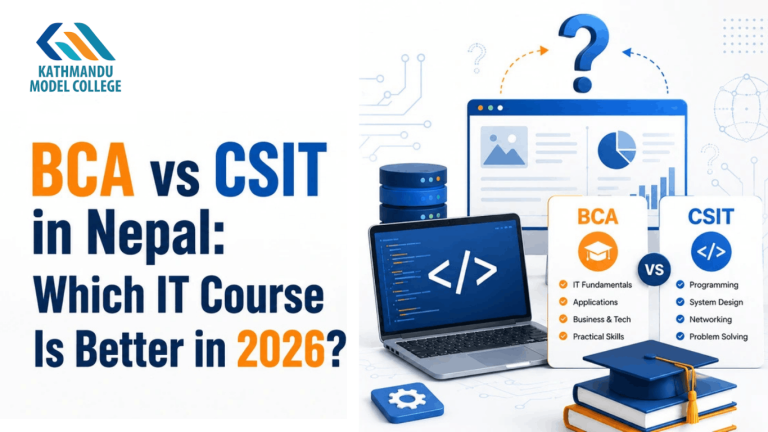
BCA is application-focused, CSIT is computer science-focused, BIT is IT systems-focused, and BE is engineering-focused. All four can lead to information technology careers, but the path and the type of work each prepares you for are different.
BCA: Best for Practical Computer Application Skills
BCA, or Bachelor of Computer Application, is one of the most practical bachelor’s courses in IT in Nepal. Introduced by Tribhuvan University (TU) under its Faculty of Humanities and Social Sciences, BCA is a 4-year, 8-semester program designed specifically to produce skilled programmers and software developers with broad technical knowledge of business, industry, and government.
What sets BCA apart is its application-first orientation. Where some IT courses ask students to understand how computing systems are theoretically constructed, BCA asks students to use technology to build software, websites, database systems, apps, and digital solutions for real problems. It is also one of the most accessible IT degrees in Nepal in terms of eligibility, open to students from all +2 streams, regardless of whether they studied science, management, or the humanities.
A BCA student typically covers:
- Programming languages like C, Java, Python, and web languages
- Web development covering HTML, CSS, JavaScript, PHP, and frameworks
- Database management using SQL, MySQL, and relational systems
- Software engineering and system design
- Computer networks and fundamentals
- Cloud computing basics
- Cyber law and IT ethics
- Real-world IT project work integrated across all years
BCA may be the right fit if you:
- Want practical software, web, app, and database skills from early in your degree
- Prefer building and creating over studying computing theory
- Want to enter software companies, startups, freelancing, or digital agencies
- Are not from a science-heavy +2 background but want a genuine IT career
- Want to build a portfolio and internship experience while studying
For a detailed side-by-side breakdown, see the BCA vs CSIT in Nepal guide.
BSc CSIT: Best for Computer Science Theory and Technical Depth
BSc CSIT, or Bachelor of Science in Computer Science and Information Technology, is Nepal’s most computer-science-oriented IT undergraduate degree. Offered under Tribhuvan University’s Institute of Science and Technology, it goes significantly deeper into the mathematical, theoretical, and systems foundations of computing than either BCA or BIT.
Where BCA focuses on using technology to build solutions, CSIT focuses on understanding how computing systems actually work at a deeper level. That distinction shapes 4 years of coursework, the types of projects students work on, and the kinds of roles graduates are best prepared for.
Core subject areas in CSIT include:
- Programming and data structures
- Algorithms and computational thinking
- Computer architecture and operating systems
- Mathematics and discrete mathematics
- Statistics
- Database systems and theory
- Artificial intelligence foundations
- Networking and security concepts
- Technical research and project work
CSIT may be the right fit if you:
- Genuinely enjoy mathematics, logic, and abstract problem-solving
- Want to understand how computing systems are built and why they work the way they do
- Are comfortable with a theory-heavy academic load over four years
- Are interested in AI, data science, cybersecurity, or advanced computing research
- Are prepared for a rigorous and technically demanding degree
BIT: Best for Broad Information Technology Learning
BIT, or Bachelor of Information Technology, falls between BCA and CSIT in terms of orientation. Also offered through Tribhuvan University, BIT focuses on the use of IT in organisations and systems, such as networking, databases, software, web technologies, IT infrastructure, and IT project management, rather than on pure application building or deep computer science theory.
Think of BIT as the degree most directly connected to how organisations use and manage technology, rather than how it is built from scratch or how it functions at a theoretical level. This makes it a useful path for students who want broad exposure across IT disciplines without committing fully to either a development or a computer-science-heavy direction.
Core areas in BIT include:
- Programming and application development
- IT systems and infrastructure
- Networking and communications
- Database systems
- Web technologies
- Software development and project management
- Information security basics
- IT in organisational contexts
BIT may be the right fit if you:
- Want a broad IT degree covering systems, networks, databases, and software together
- Are interested in IT infrastructure, system administration, and how organisations manage technology
- Want flexibility across different IT roles without committing to pure development or deep theory
- Prefer a balanced mix of technical and organisational IT understanding
BE Computer Engineering: Best for Engineering-Focused Students
BE Computer Engineering, or Bachelor of Engineering in Computer Engineering, is the most technically demanding IT-related undergraduate degree in Nepal. Offered through the Institute of Engineering (IOE) at TU, it is a full engineering program that combines computer science with electronics, hardware systems, mathematical engineering principles, and advanced computing.
The curriculum includes subjects covering digital logic, computer architecture, operating systems, maths, physics, programming, networking, software engineering, and hardware-software integration. It is more expensive, more competitive to enter, and more academically intensive than BCA, CSIT, or BIT.
It is also the most relevant degree for students who want to work in hardware design, embedded systems, telecommunications, or engineering-level computing roles. It also carries the professional status and credibility as most engineering degrees in Nepal and internationally.
BE Computer Engineering may be the right fit if you:
- Want an engineering-level degree with the professional status that comes with it
- Are strong in mathematics and science from your +2 studies
- Are interested in how hardware and software interact at a system level
- Are ready for one of the most demanding undergraduate programs in Nepal’s IT space
- May want to pursue engineering-level careers, postgraduate engineering study, or technical roles abroad
Which IT Course Suits Your Career Goal?
Choosing an IT bachelor course is easier when you start with where you want to go, not just what sounds good. Each of the four courses has a natural fit with certain career directions, and understanding those fits can help you make a more deliberate decision.
1. Software Development
BCA is the most direct path if you want to build software, websites, and apps. As its curriculum is application-focused from the first semester, BCA students can build real projects, portfolios, and internship experience earlier than students in more theory-heavy programs. For students who want to enter software companies, digital agencies, or freelance markets as quickly as possible after graduation, BCA gives a head start.
CSIT and BE also produce strong software developers, particularly for backend engineering, systems programming, and complex software roles where algorithmic depth matters. BIT can support software careers too, especially when you pair your degree with self-learning. Software employers evaluate coding ability, problem-solving, project work, and communication as much as the degree itself.
2. AI, Data Science, and Cybersecurity
CSIT and BE Computer Engineering provide the strongest academic foundations for advanced IT fields like AI, machine learning, data science, and cybersecurity. These fields require genuine mathematical reasoning, statistical thinking, and systems knowledge that CSIT and BE build more deliberately and consistently than BCA or BIT.
BCA and BIT students also successfully enter AI, data, and cybersecurity roles, but need extensive self-study. Python, statistics, machine learning frameworks, SQL, Linux, networking fundamentals, and cloud platforms like AWS are the tools that open these doors, and all of them can be learned alongside any IT degree with the right commitment.
According to the World Economic Forum’s Future of Jobs Report, AI and data skills are among the fastest-growing global capability gaps, which means the field rewards competence more than any specific degree name.
3. IT Systems, Networking, and Infrastructure
BIT is the most naturally aligned course for students interested in IT systems, networking, database administration, IT project management, and how organisations manage technology at an operational level. This includes roles like system administrator, network engineer, IT operations coordinator, database administrator, and IT support specialist.
CSIT and BE also cover networking and systems at a more theoretical and technical level, which can support infrastructure roles in large organisations or complex environments. BCA graduates with networking interests can move into this space too, particularly through certifications like CCNA, CompTIA Network+, or relevant cloud infrastructure credentials alongside their degree.
4. Freelancing and Remote Work
BCA is the most directly useful degree for students who want to build a freelancing career or work remotely for international clients while studying or immediately after graduation. Its practical focus on web development, software building, database work, and computer applications grants marketable skills that can generate income independently of a formal employer.
BIT also supports freelancing paths in web development, IT support, and system-related services. CSIT and BE graduates with strong practical skills can freelance successfully, but the heavier theoretical load during their degrees may leave less time for the applied project-building that is needed for freelancing. Platforms like Upwork, Toptal, and Fiverr reward results over academic credentials, which is worth factoring into your course decision if freelancing is a goal.
How to Choose the Right IT Bachelor Course in Nepal?
Your decision should come from honest self-assessment, not from what is popular among your friends or most familiar to your family. Ask yourself these questions before you apply:
- Do I want to build things from early in my degree, or do I want to understand deeply how systems work?
- Am I genuinely comfortable with mathematics and abstract thinking, or do I want a more practical-first path?
- Do I want an engineering credential with the professional status that comes with it?
- Do I want broad IT exposure across systems, networking, and infrastructure?
- Which course will I stay genuinely motivated and consistent in for four years?
Your answers point toward one of the four courses more clearly than any ranking does. And whichever course you choose, your career will ultimately depend on the skills, projects, internships, and consistency you build during it.
Nepal’s IT employers evaluate coding ability, problem-solving, communication, and real project work in every technical hiring process.
Common Mistakes Students Make When Choosing IT Courses
These patterns repeat every admission season in Nepal and are worth knowing before you apply.
- Choosing CSIT or BE only because they sound more technical, without being honest about your own proficiency in maths
- Choosing BCA only because it seems easier, without committing to the project-building and coding practice it requires
- Following friends into a course without checking whether it fits personal strengths
- Not checking eligibility before applying, particularly for CSIT and BE which have stricter stream and entrance requirements
- Not starting to code until second or third year, when early practice gives significant skill boost
- Waiting until final year to look for internships
- Comparing course names instead of actual subject lists and learning environments
- Assuming the degree alone determines career outcomes, when skills and portfolio matter more
Study BCA at Kathmandu Model College
For students who want a practical IT bachelor course with a clear career direction in software, web development, databases, applications, freelancing, or digital technology, the BCA program at Kathmandu Model College is worth a close look.
Before applying, visit the official BCA course page, check the curriculum and eligibility, and speak with the admissions team to confirm the program fits your goals.
FAQs
What are the best IT bachelor courses in Nepal in 2026?
Of the 4 major IT bachelor courses in Nepal, BCA is best for practical application-focused learning, CSIT is best for computer science theory and technical depth, BIT is best for broad IT systems exposure, and BE is best for engineering-level technical study. The right course depends on your learning style, interest in maths, and career direction.
Which IT course is best after +2 in Nepal?
After +2 in Nepal, BCA suits practical learners who want to build software, websites, and apps, CSIT suits students who enjoy maths and computer science theory, BIT suits students who want broad IT systems exposure, and BE suits students who want an engineering-level degree with hardware and software depth.
Is BCA a good IT course in Nepal?
Yes, BCA is one of the most practical IT courses in Nepal for students who want to build real skills in programming, software development, web development, and database management. It is open to students from all +2 streams and is explicitly designed to produce job-ready software developers and IT professionals.
Which is better, BCA or CSIT?
BCA is better for practical, application-focused IT learning whereas CSIT is better for students who want deeper computer science theory, maths, and algorithmic thinking. For a detailed comparison, see the BCA vs CSIT in Nepal guide.
Which IT course is best for software development in Nepal?
BCA is the most direct path for students who want to build software, web apps, and databases from early in their degree. However, all IT courses can lead to software development careers if you put in extra work. What matters most in software hiring is coding ability, project work, and problem-solving, not just the course name.
Which IT course is better for students who are weak in maths?
BCA is the best IT course for students who want a technology career without a heavily math-focused curriculum. BIT is also relatively accessible. CSIT and BE require stronger mathematics knowledge and are better suited to students who enjoy logical and mathematical reasoning.
What is the difference between BCA and BIT?
BCA focuses on practical computer applications, software development, web development, and databases. BIT focuses more on IT systems, networking, IT infrastructure, databases, and how organisations manage technology. BCA tends to be more development-oriented while BIT is more IT-systems-oriented.
Which IT course has the best scope in Nepal?
BCA, Bsc CSIT, BIT, and BE all have equally great scopes in Nepal’s growing technology sector. Career outcomes depend more on the skills, projects, internships, and communication you build during college than on the course alone.