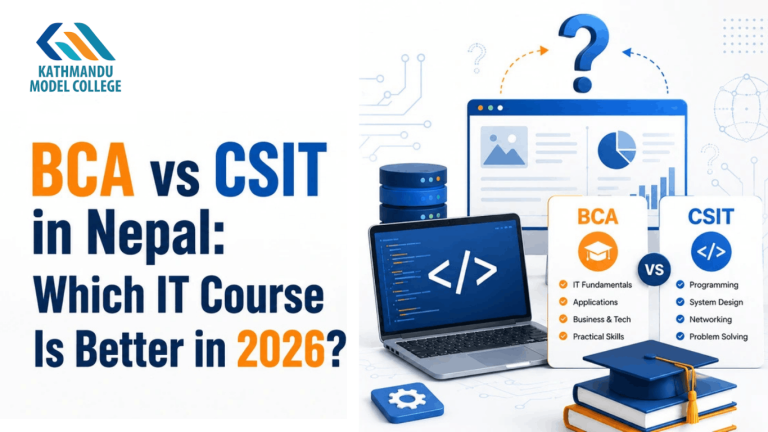

BCA vs CSIT in Nepal: Which IT Course Is Better in 2026?
You just finished +2. You know one thing clearly: you want to study IT. But then the confusion starts.
One friend says, “CSIT is better. It is more technical.” Another says, “BCA is better. It is more practical.” Your parents are asking about jobs. Your relatives are comparing colleges. And you are still stuck with the same question:
BCA vs CSIT, which one should I actually choose in Nepal in 2026?
That confusion is completely normal. Both courses can lead to real IT careers. But they are not the same course, and choosing the wrong one based on what your friend chose is a common mistake students make after +2.
The better choice depends on your background, comfort with maths, interest in coding, learning style, and the kind of IT career you want. This guide breaks down BSc CSIT vs BCA honestly so you can make a clear decision, not just follow the crowd.
Quick Answer: BCA vs CSIT, Which Is Better in Nepal?
BCA is better if you want a practical, application-focused IT course, and BSc CSIT is better if you want a more science-based computer science course with stronger theory and mathematics.
- Choose BCA if you want practical IT skills like software/web/app development, database systems, and computer applications.
- Choose CSIT if you enjoy maths, algorithms, computer science theory, systems, and deeper technical study.
Neither is objectively “better.” The better course is the one that fits you.
One more thing worth saying up front: in 2026, Nepal’s IT sector is growing fast due to increasing digitisation and Western countries outsourcing to South Asia, but the competition is growing just as fast. Employers check your practical skills, project portfolios, and internship experience before checking the degree. Whichever course you choose, your effort during college will matter more than your certificate.
What Is BCA?
BCA, or Bachelor of Computer Application, is a bachelor-level IT course focused on computer applications, programming, software development, web development, database management, networking basics, and practical IT skills.
Think of BCA as learning how technology is used to build systems, applications, websites, and digital solutions. It is built for students who want to enter IT through a practical, application-based path without being buried in science theory and advanced mathematics from day one.
A BCA student typically studies areas such as:
- Programming languages (C, Java, Python, and others)
- Web development (HTML, CSS, JavaScript, PHP, and frameworks)
- Database management systems (SQL, MySQL, Oracle)
- Software engineering and system design
- Computer networks and basics
- Cloud computing fundamentals
- Cyber law and IT ethics
- Real-world IT project work
BCA suits students who learn better by building things: by writing code, developing software, designing web pages, and solving practical problems.
What Is BSc CSIT?
BSc CSIT (Bachelor of Science in Computer Science and Information Technology) is also a bachelor-level IT course, but it leans more heavily into computer science theory, mathematics, algorithms, systems, and the technical foundations of computing.
Where BCA asks “how do we apply technology?”, CSIT often asks “how does this technology actually work at a deeper level?” It is a great option if you are genuinely comfortable with theory, enjoy mathematical thinking, and want a deeper understanding of how computing systems are built.
A CSIT student studies these:
- Programming and data structures
- Algorithms and computational thinking
- Computer architecture and operating systems
- Mathematics and statistics (more rigorous than BCA)
- Database systems and information management
- Computer networks and security
- Artificial intelligence foundations
- Data science and advanced computing subjects
BCA vs CSIT: Main Differences
| Area | BCA | BSc CSIT |
| Full Form | Bachelor of Computer Application | Bachelor of Science in Computer Science and Information Technology |
| Main Focus | Practical IT applications | Computer science and technical depth |
| Learning Style | Application and project-focused | Theory, science, and systems-focused |
| Maths Load | Lighter | Stronger |
| Best For | Students who want practical IT skills | Students who enjoy logic, maths, and CS theory |
| Career Direction | Software, web, app, database, IT support | Software, data, systems, AI, research, advanced CS |
| Student Fit | Practical learners | Analytical and theory-comfortable learners |
The table makes the split clearer than any explanation. BCA is more application-focused. CSIT is more computer-science-focused. Both are legitimate IT degrees, though the path and learning experience feel different.
Which Students Should Choose BCA After +2?
BCA tends to suit students who are drawn to the practical, applied side of technology — the ones who want to build things, not just understand them theoretically.
BCA may be the right fit if you:
- Want to study IT without a very heavy science theory focus
- Are genuinely interested in building things — websites, apps, databases, software
- Prefer learning by doing over reading thick theory books
- Want to start building a portfolio and freelancing early
- Are interested in software companies, startups, digital agencies, or IT support roles
- Come from a management or humanities +2 background (check eligibility — it varies by college)
A simple way to know if BCA fits: if questions like “how are websites actually built?”, “how do databases store information?”, or “how can I start freelancing while still studying?” genuinely excite you — that curiosity is what BCA is designed to feed. It is especially useful for students who are more motivated by output than by theory.
Which Students Should Choose CSIT After +2?
CSIT may suit you if you enjoy the deeper, more technical side of computing.
Consider CSIT if you:
- Genuinely enjoy mathematics, logic, and problem-solving
- Are comfortable sitting with theory-heavy subjects
- Want to understand how computers and systems actually work at a deeper level
- Are interested in algorithms, AI, data science, cybersecurity, or advanced computing
- Want a strong computer science foundation that can support research or advanced study
- Are prepared for a more demanding academic load
CSIT is not for everyone. It is a rigorous course for students comfortable with technical depth and mathematical reasoning. Choosing CSIT because it sounds more impressive, or because your friend chose it, will make your four years extremely difficult if you dislike theory and maths.
BCA vs CSIT Eligibility: What You Should Check
Eligibility rules vary by university and institution, so verify with them rather than assuming.
In general:
- CSIT is more science-stream-focused because of its requirements in computer science, maths, and technical foundations. Many universities require students to have studied maths at the +2 level.
- BCA is more accessible to students from different +2 backgrounds (management, humanities), depending on the university and college.
Before applying, check:
- Whether your +2 stream is accepted
- Whether maths is a required subject
- Whether there is an entrance exam and when it is
- Whether you meet the minimum grade criteria
- Whether seats are limited (they usually are — apply early)
If anything is unclear, contact the college admissions team directly. Do not wait until admission season is already halfway through.
BCA vs CSIT Subjects: What Will You Actually Study?
Comparing only course names is a mistake. Compare what you will actually sit in class and learn.
What Subjects do BCA and CSIT share?
Both programs include:
- Programming fundamentals and languages
- Database systems
- Computer networks
- Software development
- Web technology
- IT project work
- Computer fundamentals
A BCA student and a CSIT student may both write Java code, work with MySQL, build web applications, and complete projects. The difference is in depth, direction, and structure.
BCA Subject Direction
BCA leans toward applied technology: how IT is used in real-world systems and businesses. Core subject areas include:
- Computer applications and fundamentals
- Programming (C, Java, Python, web languages)
- Web development (frontend and backend basics)
- Database management and SQL
- Software engineering
- Networking basics
- Cloud computing introductions
- IT in business and organisational contexts
- Project-based learning throughout
CSIT Subject Direction
CSIT leans toward computer science: understanding the theory and science behind how computing works. Core subject areas include:
- Programming and data structures
- Algorithms and computational complexity
- Computer architecture and system design
- Operating systems
- Mathematics and discrete mathematics
- Statistics
- Database systems and theory
- Artificial intelligence and machine learning foundations
- Networking and security concepts
- Technical research and project work
If BCA asks “how can we use this system?”, CSIT asks “how was this system designed and why does it work this way?” Both questions are valuable. The question is which one you find more interesting.
Skills You Will Build: BCA vs CSIT Side by Side
In IT, subjects matter. But skills matter even more.
Here is a practical comparison.
| Skill Area | BCA | CSIT |
| Programming | Practical and application-focused | Technical and theory-supported |
| Web Development | Strong practical fit | Also possible |
| App Development | Strong practical fit | Also possible |
| Database | Practical database use | Database + theory |
| Algorithms | Basic to moderate | Stronger focus |
| Mathematics | Usually less intense | Usually more intense |
| Research | Less central | More relevant |
| IT Projects | Practical software projects | Technical/research-based projects |
| Career Readiness | Strong if paired with projects | Strong if paired with technical skill-building |
Here is the honest truth about both courses: your degree does not automatically build your skills. You do.
Whether you choose BCA or CSIT, you still need to build practical abilities outside the classroom. That means coding regularly, building side projects, exploring GitHub, doing internships early, improving communication, and keeping up with new tools and frameworks.
In 2026, a student with a BCA degree, strong project work, and two internships will outcompete a CSIT student who has only focused on passing exams. And the reverse is equally true.
BCA vs CSIT for Software Development
Both BCA and CSIT can lead to careers in software development. The path just looks slightly different.
- BCA for software development: As BCA is application-focused, it can feel more direct for students who want to build websites, mobile apps, backend systems, and software tools. If your goal from Year 1 is to write code, build a portfolio, and enter a software company or freelance market, BCA gives you a practical runway.
- CSIT for software development: CSIT gives you a stronger theory in algorithms, data structures, and systems, which can be valuable for roles in backend engineering, systems programming, or technical problem-solving. But CSIT students still need to build practical projects to become hireable developers.
Ultimately, software employers in Nepal (companies like F1Soft, Queen’s Digital Agency, Leapfrog Technology, CloudFactory, Cotiviti Nepal, and Fusemachines) care about:
- Can you actually code?
- Can you solve logic problems?
- Do you have real projects to show?
- Can you communicate and work in a team?
- Are you able to learn new tools quickly?
The degree gets you through the door. Your skills get you the job.
BCA vs CSIT for Students Who Are Weak in Maths
BCA is easier for students who want IT but do not want a heavily maths-focused course. CSIT’s curriculum includes more rigorous mathematics (discrete maths, statistics, algorithm analysis), and if maths is a weakness, that extra load can be discouraging.
BCA still requires logical thinking, basic mathematical reasoning, and problem-solving. Coding is, at its core, a form of structured logical thought. So “weak in maths” should not mean “afraid of thinking carefully.”
But if you strongly dislike maths, hate abstract theory, and also do not want to practise logic or coding, neither course will feel easy. IT rewards consistency and patience, regardless of the stream.
The student who struggles with maths but loves building things and practises coding every day can still build a strong IT career through BCA. The student who is good at maths but never writes a single line of code outside of exams will struggle in both courses.
BCA vs CSIT Career Scope in Nepal in 2026
Nepal’s tech sector is expanding steadily. Software outsourcing, fintech platforms, e-commerce, digital government services, remote work for international clients, and homegrown tech startups are all driving demand for IT graduates. But the market is also more competitive than it was five years ago, which means the quality of your skills matters.
After BCA, you can become:
- Junior software developer
- Web developer (frontend, backend, or full-stack learner path)
- Mobile app developer (entry level)
- Database assistant or data entry/management roles
- IT support officer
- QA/testing assistant
- UI/UX learner path
- Digital technology and IT operations roles
- Freelancer (web, software, IT services)
- Startup tech team member
After CSIT, you can become:
- Software developer (with stronger algorithmic foundation)
- Backend developer
- Data analyst (entry level)
- Systems analyst
- Network or security assistant
- AI/ML learner path
- Technical officer
- Research assistant
- Advanced computer science study abroad
The Reality Neither Course Brochure Will Tell You
The degree gives you a framework. Your skills, projects, and hustle give you a career.
Students from both BCA and CSIT programs apply for many of the same entry-level jobs. In fact, at many software companies, fresh graduate hiring depends far more on a coding test, a portfolio review, and an interview conversation than on which degree you hold.
A BCA student with strong projects and one good internship will often outperform a CSIT student who focuses only on passing exams, and vice versa. The course sets the direction. You decide how far you go.
BCA vs CSIT for AI, Data Science, Cybersecurity and Future IT Fields
In 2026, AI, data science, cybersecurity, and cloud computing are the fields attracting the most attention globally, and Nepal is no exception.
Students often ask: Which course gives you a better shot at these fields?
The honest answer: No undergraduate degree alone makes you an AI engineer, data scientist, or cybersecurity professional. Both BCA and CSIT provide a foundation. What you build on top of that foundation is what actually opens those doors.
- AI and machine learning: Both BCA and CSIT students can enter this field by learning Python, studying statistics, completing relevant Coursera or fast.ai courses and certifications, and building ML projects. CSIT may offer a stronger algorithmic theory that helps in understanding the maths behind AI models.
- Data science: SQL, Python, statistics, data visualisation, and real datasets are what matter. BCA students can get here with focused self-study. CSIT students may find the statistical foundations slightly more familiar.
- Cybersecurity: Networking knowledge, Linux, ethical hacking tools, and certifications such as CEH or CompTIA Security+ are highly valued in the industry. Both BCA and CSIT can lead here.
- Cloud computing: Practical AWS, GCP, or Azure certifications carry weight here regardless of degree.
In 2026, IT specialisations are built through continuous learning, not just classroom syllabuses. Whichever course you choose, plan to learn outside of it.
BCA vs CSIT for Abroad Study and Jobs
Both BCA and CSIT can support further study and career opportunities abroad, but students should proceed with caution. Abroad study depends on university recognition, credit hours, grades, English test scores, the destination country’s requirements, course relevance, and the specific university’s admission criteria.
CSIT may fit more naturally into computer science-heavy master’s pathways because it is more theory and CS-focused. BCA can support applied computing, information technology, software development, information systems, business technology, and related master’s pathways.
But do not assume that one degree automatically guarantees better abroad options. Before planning an abroad study, check:
- Does the destination university accept your degree?
- Does your course meet credit requirements?
- Do you need extra maths or prerequisite subjects?
- What master’s program are you targeting?
- Do your grades and projects support your application?
If studying abroad is your long-term goal, start planning early.
Common Mistakes Students Make When Choosing Between BCA and CSIT
These are worth reading carefully before you apply anywhere.
- Choosing CSIT because it sounds more impressive: CSIT is not “better” — it is deeper and more theory-heavy. If you are not ready for that, you will struggle.
- Choosing BCA because it sounds easier: BCA is practical, not effortless. Coding, logic, projects, and consistency are still required.
- Not being honest about your maths comfort: CSIT has a stronger maths load. Be realistic with yourself before you commit.
- Not checking eligibility before applying: Admission criteria vary by college and university. Check before, not during, admission season.
- Assuming the degree guarantees a job: Your skills, portfolio, and communication decide that.
- Choosing because your friends chose it: Your friend’s best course may not be yours.
- Not starting projects until the final year: Too late. Build something from Year 1.
- Not looking for internships until you graduate: Companies value students who have real exposure. Internships mid-course are far more useful than internships after graduation.
- Comparing syllabuses but not learning styles: Two courses may look similar on paper but feel completely different in practice.
- Ignoring communication skills: Writing, presenting, and explaining your work clearly are career skills that many IT students neglect. It matters.
BCA vs CSIT: Which One Should You Choose?
If you are still unsure, use this to decide.
Choose BCA if:
- You want practical IT learning from day one
- Software, web, app, database, and applied IT excites you
- You prefer building things over reading heavy theory
- You want to freelance or join a startup early
- You may not come from a science-heavy +2 background
- You are ready to build a coding portfolio alongside your studies
Choose CSIT if:
- You genuinely enjoy maths, logic, and computational thinking
- You want to understand how computing systems work at a deeper level
- You are comfortable with a theory-heavy academic load
- You want a foundation that supports AI, data science, or advanced research
- You are ready for technical academic pressure over four years
Ask yourself one final question before deciding: “Which course will I actually stay consistent in for 4 years?” That answer matters more than any ranking.
Study BCA at Kathmandu Model College
If you have completed +2 and want a practical IT pathway in Kathmandu, the BCA program at Kathmandu Model College is worth a close look. The program is designed for students who want to build careers in software development, web development, database management, computer applications, IT support, freelancing, and digital technology.
Before applying, visit the official BCA course page, review the curriculum and eligibility requirements, explore the facilities and faculty, and speak with the admissions team to confirm that it fits your goals.
FAQs
Which is better, BCA or CSIT in Nepal?
BCA is better if you want practical IT application skills, while CSIT is better if you want deeper computer science theory and technical depth. Both can lead to IT careers through strong skills, projects, and internships.
Is BCA good for IT jobs in Nepal?
Yes, BCA can be good for IT jobs in Nepal if you build strong skills in programming, web development, databases, project management, and communication. The degree gives you a foundation, but your skills and portfolio matter a lot.
Is CSIT harder than BCA?
Most of the time, yes, CSIT is more demanding because of its heavier load of mathematics, algorithms, and computer science theory. BCA is more practical and applied, though it still requires logic, coding discipline, and consistency. Difficulty is relative: CSIT feels hard for students who dislike maths; BCA feels hard for students who avoid building projects.
Can BCA students become software developers?
Yes, BCA students can become software developers if they learn programming seriously, build projects, complete internships, and keep improving their technical skills. Many software roles depend more on practical ability than on the degree name.
Can CSIT students and BCA students apply for similar IT jobs?
Yes, many BCA and CSIT graduates can apply for similar IT roles, especially in software development, web development, QA, database, IT support, and tech companies. The final result depends on skills, projects, and interview performance.
Which course is better after +2 for weak maths students?
BCA is an easier IT course for students who do not want a maths-heavy program. However, students still need logic, discipline, problem-solving ability, and regular coding practice.
Does BCA or CSIT have better scope in Nepal?
Both BCA and CSIT have equal scope in Nepal, but the outcome depends on your skills, projects, internships, and consistency in learning. BCA is more application-focused, while CSIT is more computer-science-focused.
Is BCA better than CSIT for software development?
BCA is a better fit for students who want a practical software development path with web, app, and database development, as well as project-based learning. However, CSIT can also be great for software development if you are willing to learn in your own time, which may actually make you even more qualified than a BCA student. But hard work is a must.
Is CSIT better than BCA for AI and data science?
CSIT offers a stronger theoretical foundation for AI, algorithms, and advanced computing. But BCA students can also enter AI and data science fields through self-directed learning, Python and statistics courses, and practical project work. No undergraduate degree alone makes you an AI or data science professional.
Should I choose BCA or CSIT after +2?
Choose based on your learning style, comfort with maths, and career goals. Choose BCA for practical application-focused IT learning. Choose CSIT for deeper computer science and theory. The most important thing is to choose the course you will stay genuinely engaged in for 4 years, and then build real skills inside it.